Italian Studies (2021)
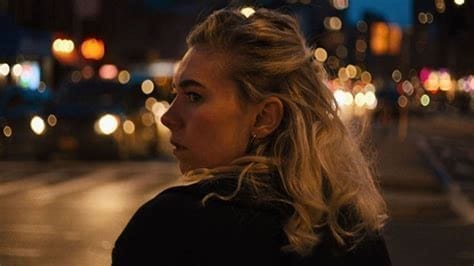
This article contains a spoiler. Although I believe that the cinema in question would not be diminished by knowing the ‘plot’ in any way, to feel the full impact, one must watch it without knowing anything about it, alone.
Does memory matter?, asks a woman.
This seemingly generic question, something one might shrug off without much thought, assumes an ominous undertone in the context of the scene from an American independent cinema, Italian Studies, directed by Adam Leon, and carried by an intensely absorbing performance of Vanessa Kirby.
One beautiful early summer day, a woman walks out of her flat and goes for a walk with her dog. She stops at a general store, ties her dog, and walks in. As she wonders hardware aisles, so does her mind. Voices begin to crowd the space: some sound like a reading from books, others being fragments of conversations. A flashback: a group of teenagers chattering excitedly. Then she sees herself, alone, clad in a black winter coat, trying to feel some warmth through a window pane which separates her from human contact. It is unclear whether they are recollections or something that yet comes to pass. A shopkeeper checks in with her, jolts her out of a trance. The woman appears disoriented. She quickly leaves the store and walks down the pavement, leaving her whimpering dog in place.
As she continues to wander the streets of the New York City, it becomes abundantly clear: she is utterly, completely lost. At times, she appears to recollect certain events. At specific spots in the city, she seems to remember fragments of specific instances from the past, including her interviewing a group of high schoolers from flashbacks.
When the night falls, the fear and the tension mounts. Along the way, she has somehow managed to lose her purse, and thus she has no access to food and shelter. She tries everything she could. She tries to negotiate a free instant noodle from an angry shopkeeper by claiming that she would come back and pay after having a bowl of noodle. She finally resorts to shoplifting at another store.
She tries to sleep in a motel room by trying to convince the keeper to give her the key to the room 234, the number she seemingly conjures up on the spot. The keeper asks routine questions: What is your name? She replies that the room is not booked under her name. The exchange forces her to walk away. Eventually, she steps into a deserted lot and relieves herself next to an abandoned shopping cart. She eventually sneaks into a dark staircase and sleeps in a landing.
Kirby is absolutely compelling as a woman in a no-man’s land. The decision to keep her British speech compounds the sense of helplessness to the narrative as an alien subject. It is another layer of challenges. Away from home, in a foreign land, she has no idea who she is and where she is supposed to be. She has suddenly found herself in a strange place, recognising nothing, including her own self.
At one point, amongst the neon lights and bustling crowd, she utters to herself.
I don’t remember who I am, or where I’m supposed to go.
And all of my memories begin with me walking among these people, and I don’t want anyone to know that.
Leon adds to the disorientation by masterfully mixing the time and the narratives: the story begins in a fresh summer day, seamlessly switches to bleak winter dusk, and continues the back-and-forth. Real events are mixed up with the events in the book titled Italian Studies, a short story collection which is, according to a friendly stranger, written by the protagonist herself. The woman goes to a library and finds ‘her book’ and reads it. She likes it, and smiles at the idea that she wrote these stories. She even borrows a pen from a stranger and autographs it, provoking an affront to the pen’s owner: library books are public property, and thus they must be treated as such. As she struggles to get hold of reality, the fictional world begins to take over.
As she reads on, Erin (Maya Hawke), the teenage protagonist of a story called Lucinda, begins to seep into the lost woman’s consciousness. In her imagination, Erin wears the identical outfit: the short yellow sleeve and brick-red plated trousers as the lost woman does. Moreover, she is friend with the same group of teenagers the protagonist will come to acquaint with. Erin is at ease, takes part in the vibrant scene of the New York City. As they sit around and chat, she declares to one of the boys in her group that she wants to become someone like him. As the story goes, Erin excuses herself from a date and goes to a live-show that night. There, she is transfixed by a singer named Lucinda at a live-house.
Later, these characters Erin encountered play a pivotal role in the fate of the protagonist. The woman makes a chance encounter with a young man named Simon at a hotdog joint. As she walks with Simon and visits various places with him, and later with his friends, seeming flashbacks from the past with these teenagers appear. At times, she is not entirely certain whether these are real memory or pure imagination. The narrative becomes fascinatingly nebulous at this point: Whose memory is it? The woman’s, or Erin’s? Or is it pure imagination?
At the height of the anxiety, the woman arrives at a sudden realisation: She needs to find Lucinda. She knows this is somehow critical, although she does not know why.
As she seeks ‘Lucinda’, she continues to mingle with ‘Erin’s friends’. At one point, they sit together at a cozy diner. They dine, and chat amicably. She repeats the story about being a published writer. Asked what the stories are about, she tells them that she did not finish reading all of them. They ask: Don’t you remember what you wrote? The woman frowns and asks: Does memory even matter? The woman appears to be savouring the temporary escape from the profound angst resulting from the loss of her identity.
Soon, the reality comes back and bites. As the group is leaving, her veneer of an accomplished adult crumbles. Despite being an only adult, she has no means to pay the bill, and this forces teenagers to split it. The woman stays with them, yet the sense of displacement only deepens in their company. She follows them to the site, and at first observes the gathering through the cold glass pane. She eventually invites herself and seeks warmth inside. She then understands: she has exhausted their welcome.
Those who once spoke to her excitedly in an interview now find her strange and antagonistic. At one point, she approaches three young women from the interview flashback, introduces herself, and demands them to identify themselves. When one of the girls tells her name, Lucinda, the woman insists that the girl cannot be the Lucinda. She shuts down the protest from confused teenagers and walks away. She then joins a group of boys smoking outside. She sees ‘the boy’ from the story about Erin and tells him exactly Erin told him: I want to become a person like you. Yet, this is not a story, and she receives a cold shrug from the boy: But you don’t know me.
So then, does memory even matter? It absolutely does. It is the only thing that can give us the point of orientation, if you will. Without knowing who you are, you cannot have a point of reference to begin making sense of the world.
Then again, what if your reference point is an unreliable one to begin with?
It is interesting to note: this cinema was shot right before the emergence of COVID-19 pandemic. It was premiered at Tribeca Film Festival in on 12 June 2021, at the height of public health crisis. The film was released on 14 January 2022, during the onslaught of Omicron and Delta variants. Whilst the theatres in the NYC were allowed to operate by then, the pandemic had already transformed the general habits of the populace, including their viewing habit. In short, our retreat from the public sphere had become entrenched, as the public division regarding vaccination and face-mask raged on.
Today, the memory of the pandemic feels distant. Whilst SARS Co-V-2 virus is still circulating, and the research on ‘Long COVID’ continues on, the pandemic and its memories seem slipped out of public consciousness. We forget that the once dominant virus can still be lethal. We forget how it felt when the streets were devoid of traffic, and how quiet the world became. As we go along with our daily routines, we act as if nothing has changed, precisely because we no longer remember the pre-pandemic norms.
I have chosen to recollect the pandemic due to the curious production timeline of this film, yet the COVID-19 is not unique: history is littered with collective amnesia. One might point fingers at the ever accelerating information overload. One might even say that it is a part of natural cognitive function to forget. Still, one needs not be a trained historian to understand: When one learns nothing from history, one is destined to repeat it.
Then, we owe ourselves a question. Is it better to fall in a collective amnesia than a personal one? If one suffers something collectively, is it more tolerable, acceptable, or even desirable? If your answer is positive, then why?
Italian Studies offers a rare glimpse of the sudden fissure in one’s understanding of the self and the world without falling back to commonplace gimmick, that is, some catastrophic event that develops narrative into popular territories, such as psychological thrillers, espionage, or a dark family dramas. Ironically, it is the very reason why it is so intensely arresting. It brings home how fragile our relation to the world around us can be. All it takes is a lapse in one’s memory about who you are. If you lose touch with this reference point, you are lost at sea, and there is no guarantee to find a solid ground again. If you think about it, there is nothing more unsettling than the subject of this cinema.
Let us then ask ourselves once more.
Is it less terrifying to suffer a collective amnesia than a personal one?