Entre Deux Choses
This year, I began to resume the habit of visiting local cafés. The network of public transportation makes it quite easy to get around for a non-driver like yours truly, and thanks to thriving café culture, I count several places to sit for a few hours to study the atlas of my mind.
The choice depends not so much on accessibility. It is dictated by the specific needs of the moment. Sometimes, I remain close to home, where the sense of familiarity gives me comfort. I cherish my walk on a wet pavement covered with brown leaves and moss from a bus stop. Other times, I look over the speeding tail lights on wind-swept streets under the stark shadows of new building blocks. I also like to sit amongst the travellers at a local café adjacent to a hotel lobby in downtown. There, you never see the same faces again, except busy baristas who give me faint signs of recognition as I escape the busy street and settle into a secluded warmth.
It is perhaps a standard cultural reflex to cite Charles Baudelaire in this instance. His notion of spleen, the highbrow urban melancholia amongst the sea of strangers, has been canonised, for a good reason: there is a strange comfort in the act of disappearance if one’s basic needs are met, although, to have a taste of it, you needn’t be as privileged as the French poet who, albeit with somewhat restricted access, survived upon his trust fund.
This blue-tinted pleasure, however, is not exclusive to the non-provincial cities. Despite the Baudelairian spleen’s association with the City of Light, if one is willing to strip down the seductive façade and tease out the structure of the experience, it becomes clear: the French poet was gesturing at something he was not prepared to conceptually articulate with this notion. He captured the affection, and found the perfect expression for it, yet unwittingly limited the scope of its application.
To begin, allow me to reflect upon the charm of urban excursions. When you melt into the stream of life, there is a certain sense of displacement. You are amongst the strangers, who neither know nor care to know you. With this anonymity, the rigid boundary that makes up your character, closely regulated by unspoken expectations about who you are, begins to loosen.
This is not to say that, in the cloak of anonymity, you allow yourself to embark upon an escapade you would not otherwise entertain. It is just that the grip of expectations becomes slightly loose. Not enough for you to act in certain ways, but sufficient for you to notice a slight internal adjustment taking place. It is not an illusory escape promised by some storied oversea locations featured in bestseller books that turned into popular flicks. These destinations in question are close enough to home, and the duration of the stay is limited to a few hours. The visits follow more or less regular patterns. As you settle on one place or another as your regular haunt, you begin to recognise faces, and even acquaint with some. In short, you find comfort in its regularity while savouring its fleeting nature.
Notice that there are two specific elements to this experience: the perceived permanence and the present mutability. As we appreciate the fleeting nature of experience, we notice that this pleasure is only possible due to the underlying sense of constancy: we expect that certain unchanging elements that constitute our daily experience to give us comfort, whilst leaving just enough space for us to loosen social expectations upon our roles. You find that the constance and the ephemerality are integral parts of this sensation. You cannot appreciate one without the other. And, this is where this amber-tinted sensation transcends the Baudelairian notion of spleen. It is perhaps more accurate to think of it as wistfulness, which is not inseparable from a particular cityscape.
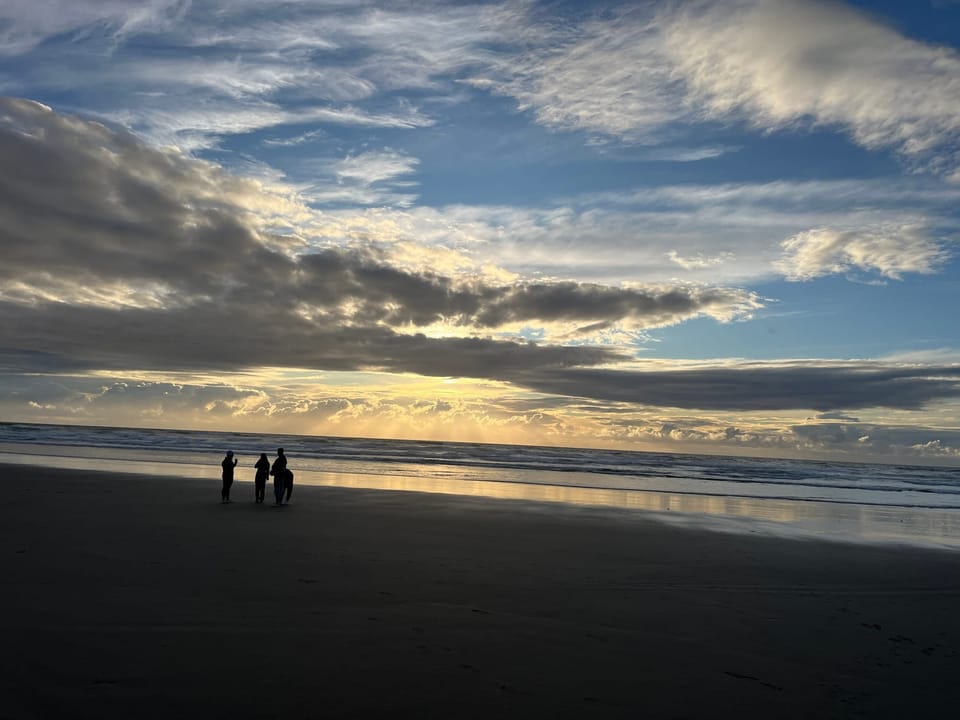
This wistfulness we feel in suspension between the permanence and the mutability is precisely what we feel on the beach. Whilst the blue expanse itself is constant, the waves are transient. The grey stretch of sand greets you as expected, yet you never know precisely what you might discover as you step onto it. Some days, a usual variety: broken crab shells, pincers, and legs amongst strands of seaweeds and empty shells. Other days, exotic human artefacts and enormous amount of beached jellyfish gleaming over the smooth wetness. Over the horizon, the sky itself is permanent, yet its face is changing constantly. The point is, we embrace both. We cannot find one beautiful without the other.
To experience this, one must exercise the attentiveness of a visitor to Rikyū’s tea house. It is neither exclusively about the formality of ceremony nor the tea itself. It is about the space which temporarily suspends us between the permanent and the mutable so that we realise the truth about the human condition: we are constantly suspended between these two.
Permanence as a transcendental concept which we can only have a faint glimpse through representations, and mutability of our earthly experience.
It is nearly impossible to name this feeling. Perhaps it is better for us to just point to the great expanse, and leave the rest to a poet.